Thursday, September 1, 2016

Triumph of the Edge: Samsung's curves are much more than a gimmick

The gadget world moves fast, and tech innovations almost never keep pace with the wild ideas designers and engineers dream up.
Some companies like Apple like to wait until technologies are mature before integrating them into products. Others like Samsung take a different approach and throw many things at the wall in hopes a few will stick. Neither approach is wrong.
With the launch of Samsung Galaxy Note7, the best smartphone you can buy in my opinion, it's worth taking a look back at how Samsung turned its "gimmicky" and "niche" curved-screen edges into a signature design element on its flagship phones.
To understand the Note7 design, we need to take a trip down memory lane back to 2014. Instead of a just a single Galaxy Note 4, Samsung also released the Galaxy Note Edge. The Note Edge was the first Samsung smartphone with a curved edge. 
Technically speaking, the Note Edge had two separate displays: the main flat portion of the screen and the curved edge panel that ran along its right side. 
The Galaxy Note Edge released in 2014.

The Galaxy Note Edge released in 2014.
IMAGE: LIZ PIERSON/MASHABLE
Samsung touted the Note Edge as the ultimate productivity phablet combining the Note 4's S Pen stylus and dual-app multitasking features in Android with a bent display that could provide quick access to app shortcuts and notifications.
Samsung changed the conversation from being "Why own a big phone?" to "Why own a phone that looks like every other phone?"
Though Mashable Tech Editor Pete Pachal really liked it, the phone's extra $100 premium over the regular Note 4, asymmetrical design and wider width — not to mention the panel's limited third-party support — ultimately doomed it.
The Note Edge was written off as a gimmick by many. iPhone fanatics, who were just starting to get behind the idea of a phablet with the the iPhone 6 Plus, laughed at it.
Samsung may have failed with the Note Edge in terms of selling it in large volumes, but it succeeded by implanting its futuristic design into the public consciousness.
By launching the Edge Note, however proof-of-concept it was, Samsung changed the conversation from being "Why own a big phone?" to "Why own a phone that looks like every other phone?"

One foot in and one foot out

In early 2015, Samsung aggressively moved to turn the Note Edge's single-curved edge panel into a real differentiator between it and other phones.
But as usual, Samsung had one foot in and one foot out. It couldn't commit to such a radical change.
And so we got the Galaxy S6 and S6 Edge at the same time. The two phones were identical save for the dual curved edges on the S6 Edge. And again, the S6 Edge commanded a $100 premium over the flatscreen model.
Galaxy S6 vs. Galaxy S6 Edge

Galaxy S6 vs. Galaxy S6 Edge
IMAGE: LUKE LEONARD/MASHABLE
Mashable ended up concluding the regular S6 was a better phone than the S6 Edge on account the extra hundred wasn't worth it just for the curved-glass aesthetic. And not just that — the S6 Edge's "Edge" features were also less useful than the vision the Note Edge laid out since it didn't even have shortcuts to apps, only shortcuts to five of your contacts.
Months after the S6 Edge's release, Samsung still wasn't sure what to make of it. There were reports the regular Galaxy S6 didn't move the needle and Samsung underestimated the demand for the curved model. And by the time Samsung got the mix right, consumers had moved on to either an iPhone or one of the many cheaper midrange phones that started to offer premium design and features for a lot less.
Maybe it was the extra premium or maybe the Edge features were too gimmicky. Whatever the reason was, there was one thing consumers couldn't ignore about the S6 Edge: It looked hot as hell — like a device from the future. Samsung just needed a better reason to hook people in on the curved glass beyond mere looks.
One thing consumers couldn't ignore: The curved edges on the Edge phones looked hot as hell.
In the second half of 2015, the company release the Note 5 and S6 Edge+Once again, the two phones were virtually identical internally. 
But Samsung sent a mixed message to consumers again. While the Note 5 was marketed as a phablet for power users (it's got the S Pen, after all), the S6 Edge+ was marketed as more of a phone for consuming entertainment. 
The distinction would have worked if not for the fact the S6 Edge+ had additional Edge panels like the app shortcuts that were missing on the S6 Edge. With the extra features, the S6 Edge+ was arguably well-suited for productivity, too... minus the S Pen, of course.

A firmer stance on the Edge

The benefits of the Edge's curved screens were better marketed this year in the Galaxy S7 and S7 Edge.
As before, Samsung kept the specs the same on both phones. But this time, there were good reasons to buy the Edge model over the regular one: a larger screen, useful Edge features and a larger battery. Samsung finally justified the $100 premium.
Anecdotally, I've seen more S7 Edge's in the wild than I've seen the smaller S7, which isn't a surprise.
The appeal of the S7 Edge goes beyond its curved-glass features. Like its Edge predecessors, it's more fashionable than flatscreen phones, which all look very similar at this point. The Edge's curved glass sides literally give it an aesthetic edge over the iPhone. 
The curved screen edges are no longer an experiment, a gimmick, a nasty bend that catches unwanted reflections for the sake of design.
As I wrote in my Note7 review, Samsung's curved glass has evolved quite a bit over the past couple of years and it's finally culminated into the phone's gorgeous design.
For two years, Samsung wasn't sure if the Edge's curved screen would stick. With most critics giving the Note7 rave reviews, it's pretty obvious now that merging the Note7 with the Edge was the best decision Samsung's made in years.
The Note7 gives you all the productivity features of the S Pen and Note series and all the power-user features from the S7 Edge. 

Samsung's Edge is now the thing that makes a Samsung phone a Samsung phone and everyone knows it.

Samsung Galaxy Note7 shipments delayed amid reports of exploding batteries

The well-reviewed Galaxy Note7 from Samsung has, unfortunately, run into a major technical problem that may taint its otherwise successful launch. 
Distribution of the Galaxy Note7 is reportedly being delayed due to a new, unexplained series of product quality tests intiated by the South Korean electronics giant. 
"Shipments of the Galaxy Note7 are being delayed due to additional tests being conducted for product quality," a Samsung spokesperson told Reuters on Wednesday. 
Although the company did not elaborate on what the specific quality control issue is, the same report mentions claims of exploding batteries from local news sources in South Korea. 
And contrary to the aforementioned "delayed" statement from Samsung, South Korea's Yonhap News Agency claims that shipments of the device have been completely halted in the wake of various reports of the Galaxy Note7 exploding while charging its battery. The report cites five claims of exploding devices since Aug. 24.  
A user posted a damaged Galaxy Note 7 on Baidu amid claims that the device's battery may explode while charging.
IMAGE: VIA BAIDU
In recent days, photos have begun to crop on sites like Baidu showing what some users claim are Galaxy Note7s that have allegedly suffered accidental fire damage. However, there has been no confirmation from Samsung that the burned phones showing up online were definitely impacted by battery or charger malfunctions.  
The Korean Herald reports that Samsung is investigating the matter and may release the results of that investigation soon. 
Samsung did not immediately respond to a request for comment.

Leaked details reveal Samsung Gear S3 could come in three versions

The next Samsung smartwatch might not be a single model, but three, according to a new report.
SamMobile reports Samsung's Gear S3, which is expected to be announced at IFA next month, might come in three versions: Classic, Frontier and Explorer. 
The names Frontier and Explorer could hint at a more active-focused lifestyle or ruggedized design. A separate report from the Samsung fan blog claims the Gear S3 will have a built-in integrated GPS, an altimeter, barometer and speedometer.
The Gear S3 will likely stick with its round display and rotatable bezel, which is used for navigating around the Tizen operating system.
The Gear S3 might have a built-in integrated GPS.
Furthermore, the report claims the Gear S3 Explorer model will come with three buttons located on the two, four and 10 hour marks. If we were to guess, we'd say these buttons might be used for stopwatch functionality or perhaps as programmable shortcut buttons to launch apps.
Perhaps, the buttons could work like the Galaxy S7 Active's "Active" key, which can be used to launch an programmed app, or send out an emergency message.

All should be revealed soon enough. Mashable will be reporting live from from IFA

Green like Esmerelda

Women put up their hair and on their stern faces
To catch their mates at the scene of a crime
They created in their own minds
With hearts bursting with love
And fears large as the distance between them.
The muscles still ripple beneath the skin-tight shirt,
The strut still counters the booty shake,
Or so the earth still confirms as true,
Like it says her blue eyes still beguile the moon
From the sky.
                         But all that is unacknowledged
In their dance, the trading off of silence
Of couples games that seem so deadly
But are only play.
If I was a poet
                           I would get some kind of award
For the most times married, still it's the lovers
I reflect on, how I stayed in their corner rooms
For the poignancy of conversations in front of
Old televisions, with their mothers' serving spoons
As the buzzards circled the rooftops.
It always ended the same, they all died poor and lonely
After leaving me, and though I liked to wallow
In the pathos, I always found some misplaced stone
Who gave forever in the touch again,
Who went through every pore
And lived in every atom
Until there was no notion of a separate me anymore,
A kind of passion that can only come
From the deepest part of the stars.
Always the same woman,
Always all women,
The deeper they revealed their soul the more true that was,
So it was easy to be true -- for me at least
If never quite for her -- I can only follow,
Say "yes" to her resolute "no",
Give her emotion some legitimacy,
As if I have no skin,
As if it wasn't a game,
As if everything I say
Isn't her.
As we sit in the outdoor cafe,
Black tiles gleaming like a crossroads
Of nostalgia and longing,
She still all of them: this one's laugh, that one's
Sudden glee, another's snide response,
But it is still as distant as it always was,
An inexplicable eruption of grace, annoyance,
Savagery, pleasure, sweetness, calm, wisdom ...
From some place I cannot go
No matter how tightly I grip her hand.
Words pass but immediately dissolve,
Energy merges but at the service of a capricious puppeteer,
Looks say what they mean but the mood keeps changing
Like the lights of the day on a quest beyond our meanings.
It seems as if our positions will be stone
Left to weather the elements alone,
But then a blue sarong comes along to remind me
Of what each put aside for the other,
The space we've held for a never quite revealed mystery;
Bought from a beach peddler it becomes the rug
That ties the room together, all dissonance and distance
Falls away, into the radiance of a body
Moving like the surf toward me.

Tom Brady's Hair

No one saw this coming
the dominance this year
how effortless it moved the ball
through beasts and schemes and snow,
so strong and multi-layered
so perfect like Apollo,
with nods to every football decade
of hair: the shag, the crew, the mullet,
from Bobby Layne to Willie Joe
to something once barbaric,
like the first white guy to wear a pink tuxedo
no quarterback dared pull this off before,
and it's well-thought-out, superb in all its details
it's not a tawdry gimmick or a trick,
no pseudo-Rastafari braids or Polynesian fro
it's a coif of the messiah
that jostles in the wind
like Jehovah's very breath.

No one saw this coming
this Samson per Giselle,
no one imagined Belichick
would have his finest hour
in the autumn of his career
by whispering, from his concrete-colored hoodie
in his impressionable prodigy's ear
"this off-season I need you to concentrate,
put the work into your hair."

Event Recap: High Tea With Melina Marchetta

Every so often Better Read Than Dead in Sydney hosts high tea events with Australian authors, and yesterday they had their biggest ever with Melina Marchetta. There was so much interest they had to  move the event out of their bookshop and in to a hall around the corner. They do a great job with creating a lovely high tea atmosphere, the food is awesome, and you get to hear an amazing author discuss their work - it's basically my idea of heaven. Also tickets are only $10, which is crazy good value. Seriously, I am obsessed with how brilliant these events are. And of course yesterday's event with one of my absolute favourite authors was extra brilliant.

If you're wondering what those non-Melina Marchetta books are - I won the lucky door prize, woo!

Melina discussed everything from writing Looking for Alibrandi to the On the Jellicoe Road film script and the novel she's just finished. Some of the highlights:

  • Melina left school in Year 10 and at her mother's urging did a course to learn to type. Instead of typing random things she began writing what would go on to become Looking for Alibrandi. She would write little snippets of story and pass it to the girl next to her, who kept asking for more, which encouraged her. So her very first reader was a 16-year-old girl. But she saidAlibrandi went through many, many rewrites, and even after she got an agent and later a publisher it needed work. She didn't keep a record of the process, but she believes she got rejected between five and eight times before Alibrandi was rescued from the slush pile. From the time she first started writing it through to when it was published, it took about five years. Her other novels have taken about 18 months from writing the first draft through to being published.
  • Her love of reading was what got her in to writing. She had never seen a character like herself or her world portrayed, and that's what really drove her to create Alibrandi. But although she created a story within her world and tied to her experiences growing up in Australia with Italian heritage, she said it's not her life story and Josie Alibrandi is not her: "Josie is much smarter than me and I am much nicer than her." 
  • She said "write what you know" is great advice, but that doesn't mean it has to be exactly your story - you can use your experiences or emotions to create a fictional journey: "My own life is very boring - the highlight of my day can be getting an email or going up the road to get a coffee." Melina used Saving Francesca as an example of this - working at an all boys school, she knew what it was to be a minority in that environment, and she used that in Francesca
  • She was very proud of On the Jellicoe Road but when it was first published, nobody was really interested in it. She even had a bookseller tell her to her face that she didn't like it. People wanted her to keep writing Alibrandi and Francesca again and again, and didn't know what to make of this completely different story. But then it was published in America, and it was really what cracked the American market for her, and suddenly people in Australia were interested in it too. Now it is one of her most beloved books.
  • Despite the themes of her first two books, she was never interested in writing about multi-culturalism forever - what interests her most, and what ties all her books together, is identity.
  • Melina sees Finnikin of the Rock as a companion novel to AlibrandiIt has the same theme of identity, and searching for who you are, and of people displaced from their homeland. She was inspired to write Finnikin when she was living in New York for a couple of months, and she was sitting on the subway and saw an advertisement about refugees. And as she was sitting there she realised everyone around her was talking in different accents and languages, and everyone, included herself, was disconnected from their homeland. Those two observations led to Finnikin. She wanted to write a story about refugees but she didn't want to set it in the here and now because it would be too political, so she created the fantasy world. 
  • Finnikin is almost as much Evanjalin's story, but Evanjalin didn't get a POV because she's got too much to hide.
  • The descriptive language was something she worked hard to get right when writing fantasy. While most of her novels undergo at least five rewrites, she rewrote scenes in the Lumatere Chronicles up to 20 times. She would write a scene, and then sit there with a thesauraus to find just the right word for each thing she wanted to convey, to create a rhythm within the prose. She said the important thing with fantasy is that there is a song that is sung through the writing.
  • Finnikin and Francesca were both written as standalones, but they each had characters that wouldn't leave her alone (that'd be Froi and Tom!).
  • Tom Mackee was originally supposed to be the villain in Francesca. But one comment he made in the novel - about being the first Mackee male to get to a certain age with his liver intact - stuck with her over the years. One night Melina was watching an Australian Story about Vietnam vets who were going back to Vietnam because the bodies of five soldiers had never been recovered, and she had a "mystical moment" where she felt Tom Mackee sitting next to her saying "that's my grandfather." He also said "and Georgie Finch is my aunt" - she had been thinking of Georgie as a character for another story at the time. She said she doesn't really buy into what a lot of writers say about things just coming to them, or that writing is some mystical process - "it's mostly really hard work" - but that was one of the few moments she's had like that. And that led to The Piper's Son.
  • Jimmy Hailer's story is very much in Melina's head right now. He and Siobhan did not appear in The Piper's Son because she could only include who Tom brought with him, and he didn't bring those two characters, but she was aware their absence was a presence that was felt, and they were still there even if they weren't an active part of the story. She has been thinking of Jimmy in the past two days in particular, and she knows what will happen in his story, but she needs to get the chance to write it. She said she firmly believes stories are written at the right time - and she feels that now is Jimmy's time. She wanted to stress that it won't be YA - Jimmy is about 25 or 26. He is still drifting, as Jimmy does. He will get stuck in a house for three days due to a flood, with another character who was in a short story Melina wrote last year (I have yet to read that one - I need to).  There will be two other main characters, in their 40s - another woman who was in that short story, and her love interest. It will be about these four characters, but the old gang will definitely show up in some way. 
  • The novel Melina just finished is unlike anything she's written before. Her agent describes it as a "literary thriller" and it is an adult novel set in London. It's about an explosion on a bus that is tied to an explosion on the London underground 14 years earlier. She said while in the past her novels have been about young people where older people play an important part, this one is about older people, where younger people play an important part. It was partly inspired by Melina's feelings over anti-terror laws. 
  • Melina is currently tinkering with the Jellicoe film script. She said it has to be absolutely perfect because they're hoping to get the right backing in the new year to finally get it made. They've auditioned actors and she said if it was made tomorrow, she knows they definitely have a Jonah Griggs, Ben Cassidy and Jude Scanlon - and they are all "amazing, and hot too". But she can't say who they are because by the time the film gets made they might not be able to do it for whatever reason (Hollywood might snatch them up - "and Hollywood will definitely snatch them up" - or they might get too old, for instance).
  • Melina said film scripts are incredibly difficult and complicated because there is a lot more to consider than when writing a novel. And the people who are funding it are not necessarily interested in what's in the novel. It sounds like the Jellicoe script might be quite different from the book, but she said the "six most important things" that are in the novel are also in the script. She also said that everyone who has read the script has loved it.
  • Her advise for writers: just write! Melina said she meets a lot of people who say they want to be writers but aren't actually writing anything, and she understands the difficulty of putting things on the page and the fear that it will never live up to what's in your head. She said her latest novel was in her head for a year before she put anything to paper - and it ended up being even better than what was in her head. She said you need to write something every day - it doesn't have to be much, and you might end up throwing out three quarters, but that one quarter might be the hook you need to hang the next thing on. Even if one sentence out of hundreds is gold, it's worth it and that's what you need to do. 
  • You should also rewrite, rewrite, rewrite. Melina said people ask her how she, for example, plants something early in a book that doesn't have meaning until much later on, and she said that's the sort of thing that comes through rewriting. It's only when you rewrite that you really know the characters and can really flesh them out and add those little, meaningful details. But you need to get that first draft done as the foundation to then go back and rewrite and make it better.
  • Melina is the queen of YA and it seems she will soon be the queen of adult fiction too - of course she didn't say this, but I am. If you haven't read her books you should go buy them all right now.

Book Vs Movie: The Neverending Story

The Neverending Story was one of my favourite movies as a kid, and having recently read the book, I thought it was time for a revisit. Did it stand the test of time? Well... yes and no. The special effects obviously aren't great, and the acting is really, really bad. But the story is still pretty magical. It may be the nostalgia talking, but I still enjoyed it. Even though I laughed at it way more than with it. On to the comparison...

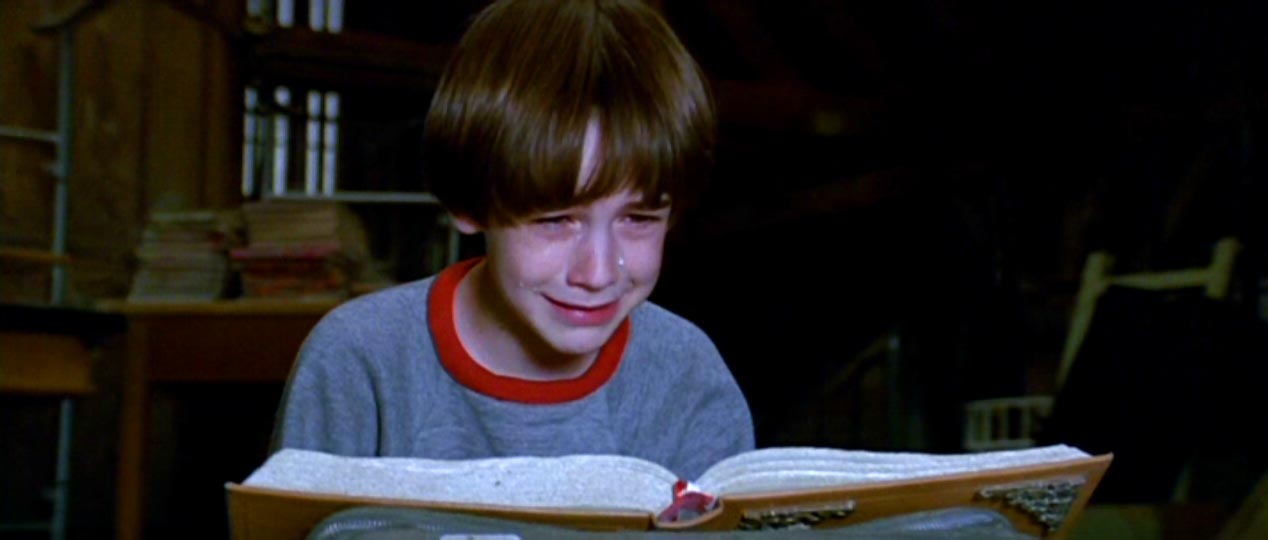
Note to filmmakers: getting a kid to scrunch his eyes up and splashing water on his face does not equal realistic crying.
Changes that worked
  • The land was named Fantasia in the movie, rather than Fantastica. Maybe it's because I grew up with the movie, but I much prefer the name Fantasia. 
  • We first meet Atreyu in the Ivory Tower, rather than his own land. I can understand why this was done - I'm sure it was for budget/time reasons, but I liked how it moved us straight in to the action.
  • Atreyu doesn't have green skin, but really I think it would have just been distracting. Apparently the filmmakers did experiment with turning the actor's skin green with a few different techniques, but nothing looked right. I'm glad they passed.
  • Artax the horse can't speak as he can in the book, but again I think it would have just been cheesy if they had carried this over to the film. Plus Atreyu has the ability to understand him, anyway.
  • There were only two gates to get to the Oracle, not three. It's not as pretty or "magical" a number, but I can see why it would have been cut for time constraints. The Oracle itself is a pair of sphinxes, rather than a bodiless "song" - again, I can understand why this change was made. As it was in the book I don't think it would have worked on screen.
  • The Nothing looks like a storm, rather than literally nothing. Again, the book version wouldn't have worked in a visual medium.
  • Atreyu meets the Rock Biter. I liked that it tied the beginning of the story in to the larger narrative.
  • We see Falcor and the other characters almost immediately after Fantasia is restored, as opposed to the numerous chapters it takes to get back to them in the book. They're the characters we've come to care about, so it makes sense to continue the journey with them as soon as possible.
  • The movie only covers the first half of the book - but where they end the story makes a lot more sense than the way it was dragged out in the novel.
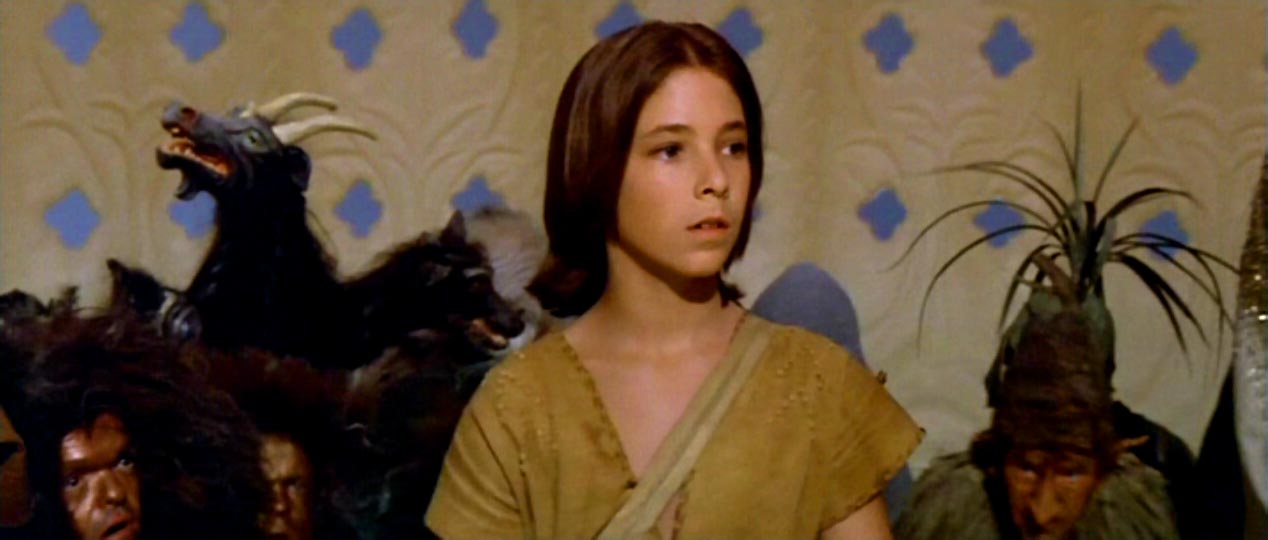
I used to think Atreyu was dreamy. Huh.
 Changes that didn't work
  • In the book, Bastian's dad is still mourning the loss of his wife and barely functioning, neglecting Bastian as a result. Bastian, while he misses his mum, wants to get on with life, and part of the beauty of the book is the way his journey ultimately takes him back home - to his dad, and to love. In the movie, however, it is Bastian who is struggling to cope without his mother, while his dad urges him to move on. His dad is caring but distant and a little hard on him. I just felt Bastian's loneliness was more palpable in the book, where he had effectively lost two parents at once. The movie also didn't resolve Bastian's relationship with his father, which was frustrating.
  • The book-within-the-movie, The Neverending Story, is described as a dangerous, one-off magical item, whereas the book-within-the-book was just one of many pathways to Fantastica, the land of stories. The movie version weakens the allegory of what it means to get lost in a story. In fact, Fantasia is described as the land of dreams, not stories, in the film. Not the same thing!
  • When Bastian takes the book, he leaves a note saying he'll bring it back - something he doesn't do in the book. While this makes him a nicer character, it doesn't explain why he has to hide away in the school attic all day, creating a plot hole.
  • AURYN's power isn't explained properly, so, for example, it's not clear why Atreyu isn't pulled down by the sadness in the swamps.
  • Falcor rescues Atreyu, not the other way around. This is pretty random and doesn't explain Falcor's devotion to the boy.
  • The Nothing doesn't seem as threatening as it does in the book - people don't feel the compulsion to walk in to it (that, for me, was the scariest part). We even see Falcor flying through the Nothing - which makes absolutely no sense. It's not Nothing if you can fly through it! OK, it's not Nothing if you can see it either, and I said that worked for the film - but having Falcor and Atreyu travelling through it just makes it seem even less frightening.
  • The Empress is much less empowered in the movie. She doesn't take action herself, as she does in the book. Leaving zero strong female characters.
  • The Empress gives Bastian sand, "all that's left of Fantastia" to make a wish, instead of AURYN. Seriously, why did they bother putting AURYN in the movie if they weren't going to make use of it?!
  • After Bastian restores Fantasia, EVERYONE comes back, "like the Nothing never was". I'm all for a happy ending, but even Artax comes back - and he didn't even die because of the Nothing. He died because of the swamp. It makes no sense, and again undermines the danger of the Nothing in the first place.
  • Bastian flies on Falcor's back through New York City (don't ask me how they get there) to take vengeance on his bullies. An eye for an eye isn't exactly a good message (though perhaps I'm particularly sensitive to that thanks to the current atmosphere in blogland), but moreover - it's just tacky, cheesy and really, really lame.
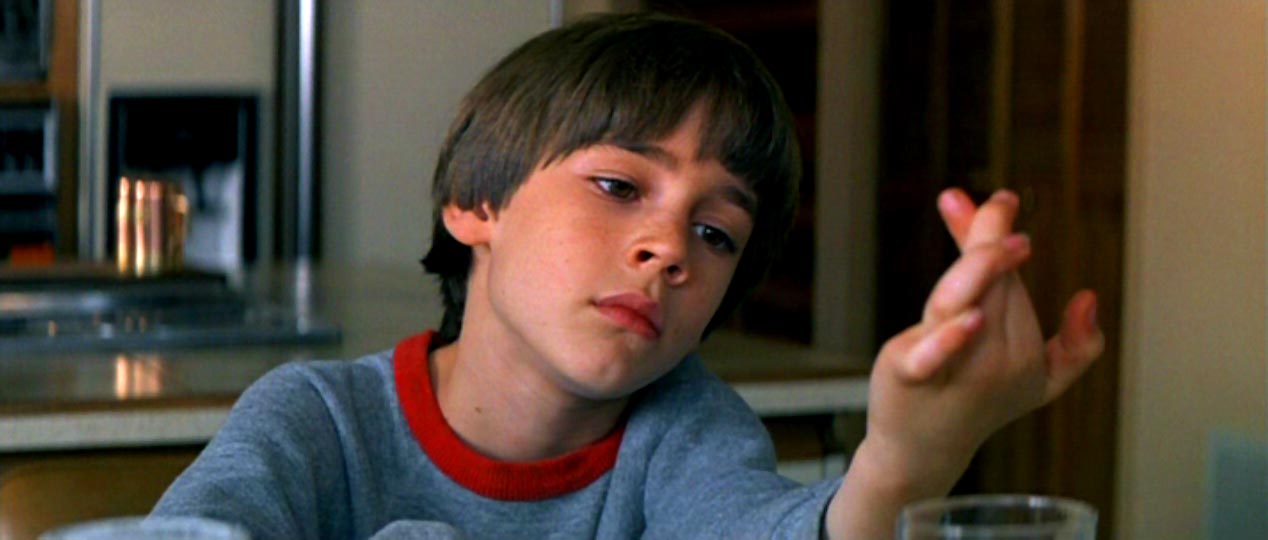
    Remember the finger thing?! I didn't until I saw it again and then had all these flashbacks to my friends and I trying desperately to get our fingers to do that. I don't think any of us succeeded. Luckily, we didn't break any fingers either.